
The Crusades: What You Really Need to Know
Historical Context: This Gets Complicated Fast
What were the Crusades really about? Most of us learned they were religious holy wars. The truth is messier than that—but also clearer in one vital respect: the Crusades were necessary responses to serious military and religious threats against Christian lands and peoples.
The Crusades weren't simple religious warfare. Modern historians dig into a mix of causes (both Christian and Muslim) acknowledging the tangled political, economic, religious, and military forces at play. Yet at their core, they were defensive wars sparked by centuries of Muslim expansion and conquest directly threatening Christian civilization and sacred sites.
Early Islamic Expansion: 7th to 11th Centuries
Picture 630 AD. Muslim Arab forces, newly unified under the Rashidun Caliphate and later the Umayyad Caliphate, began spreading across Byzantine-controlled territories. Syria fell around 639. Egypt came next in 642. Between 647 and 670, Muslim forces gradually took the Exarchate of Africa. Jerusalem shifted to Muslim control in 637. By the end of the 11th century, Muslims ruled about two-thirds of the ancient Christian world, including Palestine, Syria, Egypt, and Anatolia.
This expansion was motivated by a combination of religious zeal—jihad—and political ambition. These conquests uprooted Christian communities that had flourished for centuries, severing Christian access to key holy sites. Christian Byzantium and its people endured tremendous pressure, their empires exhausted by previous conflicts and their societies vulnerable.
Some local Christian populations, such as Monophysites, Nestorians, and Coptic Christians, initially accepted Arab rule as liberation from Byzantine oppression. Yet over time, unchecked Muslim territorial gains brought growing hardship and rising intolerance towards Christian worship and pilgrimage.
When the Real Crisis Arrived: Seljuk Turks
The Byzantine Empire faced a new problem in the 11th century—not from Arab caliphates but from the Seljuk Turks, fierce warriors with new tactics and ambitions. After the Battle of Manzikert in 1071, the Seljuks seized large portions of Anatolia, moving perilously close to Constantinople.
Desperate, Byzantine Emperor Alexios I Komnenos appealed to Pope Urban II for military aid to protect Christendom's eastern frontier. This was not a call for conquest but a plea for defense against an existential threat.
Pope Urban II's call to arms in 1095 at Clermont appealed to Christian hearts stirred by reports of persecution and the desecration of the Holy Land. He appealed to the wider Christian world to rally for the protection of their faith, their fellow believers, and the sacred sites.
The fervor was unprecedented. Hundreds of thousands responded, many poor peasants seeking hope and redemption. Most were not knights seeking glory but ordinary people compelled by a deep sense of duty to rescue their brethren and safeguard the very essence of their faith.
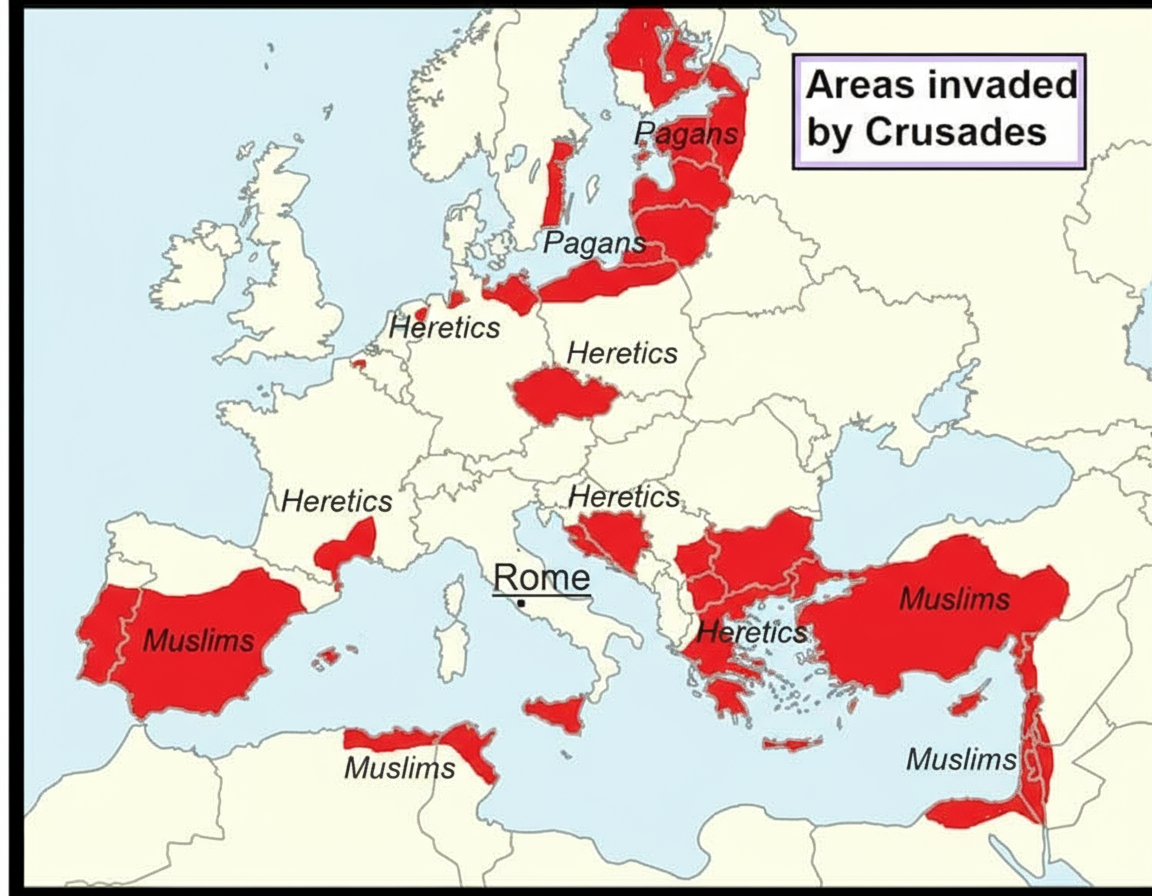
The Major Crusades: The Real Story (follow on map )
First Crusade
1095-1102
They Actually Won
What happened:
These crusaders marched thousands of kilometers to unfamiliar territory. They faced climates completely different from Europe. Their supply lines were fragile. Yet they won. July 15, 1099: crusaders captured Jerusalem. They established Crusader-ruled states across the region, known as the Latin East or Outremer. Godfrey became the first ruler of the Kingdom of Jerusalem. But victory came with horror. Historical accounts document massacres of Muslim and Jewish residents. Contemporary Muslim sources counted around 3,000 deaths. Later accounts wildly exaggerated the figure to 10,000 or even 75,000. The truth sits somewhere in between: significant violence, but not quite what medieval chroniclers wanted us to believe.
Second Crusade
1147-1149
When Kings Failed
What happened:
These were reigning monarchs leading crusades for the first time. That was massive—a sign of how seriously Europe took this. Despite 60,000 troops and two crowned kings, this crusade fell apart. Poor planning. Logistical failures. Strategy disputes. The crusaders got crushed in Anatolia. They limped toward Damascus but couldn't maintain a siege. After four days, they retreated. The campaign was a disaster. The Secondary campaigns scored some wins (Lisbon fell in 1147) but the main objective failed. This crusade strained relations between Byzantines and Western Europe. It let Nur ad-Din consolidate Muslim power in Syria.
Third Crusade
1189-1192
Richard Wins Battles, Not the War
What happened:
Three crowned monarchs led this crusade. Richard conducted a brilliant military campaign. He captured Acre. He defeated Saladin at Arsuf and Jaffa. His tactical genius was real. But here's the problem: crusaders couldn't hold Jerusalem. Richard's advisors told him the truth. The crusader army was dwindling. Supply lines were unreliable. A siege would fail. So Richard did something pragmatic. He negotiated. The Treaty of Jaffa (1192) gave Christian pilgrims access to Jerusalem, while crusaders kept control of Acre and coastal territories. Jerusalem stayed in Muslim hands. Richard won the battles. He lost the war. The campaign also suffered from Frederick's death en route and Philip's early return to France.
Fourth Crusade
1202-1204
When Things Went Completely Wrong
What happened:
This crusade went off the rails in ways that still matter today. The crusaders couldn't afford the Venetian transportation costs. So they became mercenaries for Venice. That led to attacking Christian cities like Zara in 1202. Then came the unthinkable. On April 12, 1204, crusaders sacked Constantinople. The greatest Christian city in the world. They massacred inhabitants. They desecrated Orthodox churches. They looted religious treasures and artworks. Venice gained control of Mediterranean trade routes. Baldwin became the first Latin Emperor of Constantinople. The result? Western Christianity and Eastern Orthodoxy split even wider. The crusading ideal died that day. This shows something crucial: crusading could be twisted toward completely different goals. Economic interests, political power, and religious objectives mixed together until the original mission disappeared.
Fifth Crusade
1217-1221
Wrong Target
What happened:
Initially successful. Crusaders captured Damietta in 1219. But then the strategy fell apart. They tried to advance inland into Egypt. Egyptian reinforcements under Al-Malik al-Kamil crushed them. The crusaders were forced to retreat and surrender Damietta. The shift toward Egypt made strategic sense on paper—Egypt's wealth could theoretically fund crusader expansion. In reality, it was a military disaster.
Read the full Siege of Damietta story: timeline, leaders and sources
Sixth Crusade
1228-1229
Diplomacy Wins
What happened:
This crusade stands out. Frederick achieved his objectives through negotiation, not military force. Even though the Pope excommunicated him, Frederick negotiated with Egyptian Sultan Al-Malik al-Kamil. The result? Christians regained Jerusalem, Nazareth, Bethlehem, and other holy sites. No destruction required. The catch? Jerusalem's fortifications weren't restored, and the treaty lasted only ten years. It showed something important: diplomacy could succeed where armies struggled.
Seventh Crusade
1248-1254
Another Egypt Failure
What happened:
Louis captured Damietta in 1249. Then defeat at Mansurah in 1250. Louis was captured and released only for a massive ransom. The crusaders held some Levantine territory, but the main goal (securing Egypt and the Holy Land permanently) failed completely.
Eighth Crusade
1270
Plague and Death
What happened:
This crusade was plagued by disease. Louis planned to reach the Holy Land via North Africa, but Tunis offered resistance. Dysentery killed Louis and many soldiers. Limited territorial gains. Heavy losses. This crusade marked the effective end of major crusading efforts in the Holy Land.
Ninth Crusade
1271-1272
The Last Gasp
What happened:
Limited operations. Minimal achievements. By 1291, Acre—the last major crusader stronghold—fell. European crusader rule in the Middle East was finished.
Beyond the Holy Land: Northern and Other Crusades
The crusading spirit extended to defense and conversion in Northern Europe (Baltic Crusades) and within Christianity itself (Albigensian Crusade against heretics). These campaigns reflected the era's intertwined concerns over faith, territory, and religious unity.
What Historians Understand Now
Historians now acknowledge the Crusades' layered motivations: religious devotion to protect Christian lands and holy sites; political ambitions; economic interests; and social aspirations. But crucially, these were defensive actions in response to genuine threats from adversaries who sought to expand territory and influence over Christian peoples and sacred places.
The Byzantine Empire's plea against the Seljuk Turks was a direct call for protection. Crusaders' willingness to endure hardships speaks to the depth of their conviction in defending their faith and communities.
The crusades altered Christian-Muslim relations profoundly, sometimes worsening hostilities but also showing attempts at diplomacy and coexistence. Recognizing the Crusades as primarily a defensive response reframes this key medieval chapter as one shaped by conflict over religious freedom and survival.
The Bottom Line
The Crusades were not unprovoked aggression but complex, necessary efforts by medieval Christendom to protect its people, lands, and sacred traditions from expanding Muslim powers. They remind us that freedom of religion and the defense of faith have long been causes worth mobilizing for—even amid great hardship.
This understanding opens the floor to vital discussions today about how societies navigate religious coexistence, conflict, and freedom amid cultural and spiritual diversity.